
Angie Faye Martin On Keeping the Joy Alive
Beejay Silcox speaks with Angie Faye Martin for The Pulse Papers, the accompanying interview series to MARION’s Hidden Nerve program.
Angie Faye Martin will be the first to admit she has “a bit of a bleeding heart”. For years, her idealism found an outlet in the public service. But as the frustrations of bureaucracy mounted, fiction offered something policy couldn't: the space to explore injustice, ask thorny questions and tell stories on her own terms.
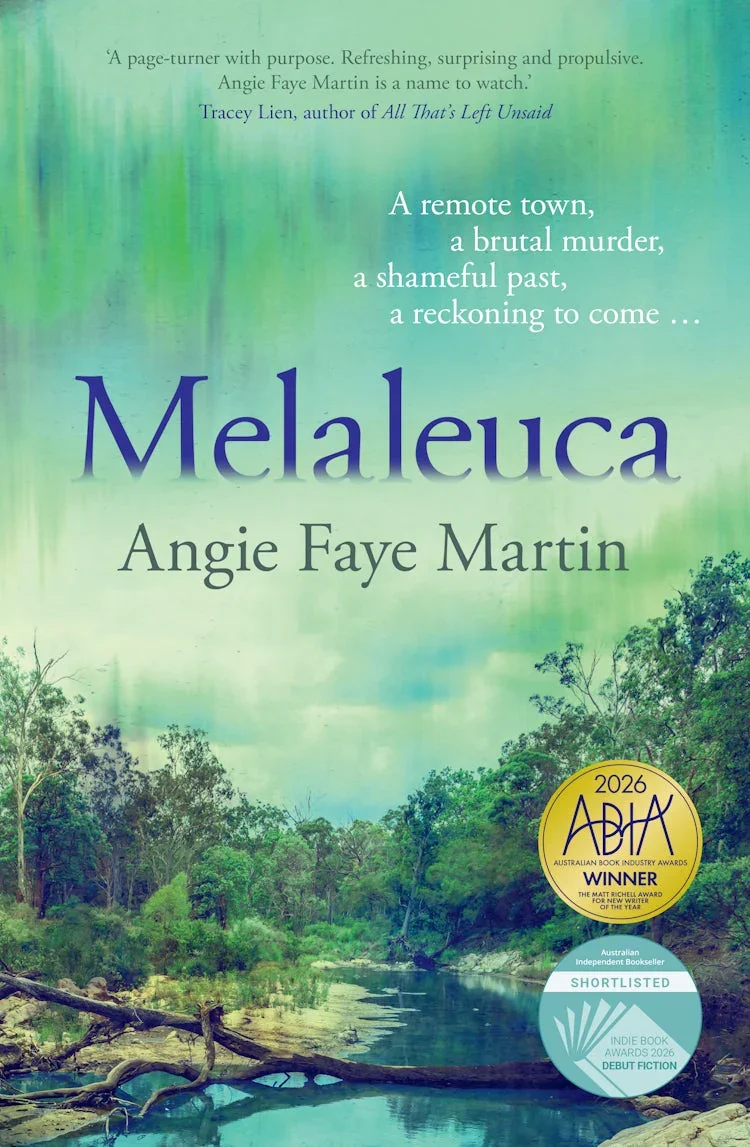
After Angie's Hidden Nerve session, we sat down to talk about the dare that launched her award-winning crime writing career, the decade-long making of her debut, Melaleuca, and why she's so serious about fun.
For a debut novel, Melaleuca has had quite a journey. How do you tell the origin story of your book?
I know not many people just think, “I'm going to write a novel” and then go away and do it. But that actually was my thought process. I was walking around the neighbourhood with my husband one day, banging on about various stuff, as I do. I was frustrated with work and frustrated with myself, and I just thought: “You know what? Fuck it, I'm just going to write a novel.”
And he said: “Go on then, smarty pants.” It almost became a bit of a dare. I remember we were walking around in Carnegie, and there were heaps of paperbark trees, and that was where the name of the book came from.
This is wild to me: you basically played chicken with yourself. But a dare isn't enough to sustain a novel. What happened next?
This was about 10 years before the novel was published. I still remember vividly thinking, “I could go home and have a cigarette, or I could just channel all of this energy that I've got into plotting.” I didn't have that cigarette, and by the end of the day there were Post-it notes all over the cupboards.
It all started with this thought: What if the people you know best, you don't really know at all? Then I went from there to humour and thought: What if a really lovely person, someone everyone admires, was actually awful?
I was at a stage in my life where big decisions were coming up. I was in my early 30s, and I was thinking: how are you supposed to make decisions in life – babies, marriage, all that serious adult shit – if you never really know anyone, including yourself?
That's really the heart of Melaleuca: the layers of people's personalities and how we make decisions about them. If I say much more, I'll be giving away spoilers. But I just got carried away with those questions, and started having fun with them.
One thing that shines through when you talk about this book is how much fun you had doing it.
It was so much fun. And once I got those big psychological hooks in place, other exciting things came to me. I realised I could explore injustice and Aboriginal histories that haven't been told before, and all these other things that I’d wanted to explore more in my day job. I kept thinking: “I can't do it in the government, but I can do it in my book.”
No one's going to put a red pen through my briefing report, or tell me to hurry up and make it more concise. Well, maybe my editor at some point. But it just felt like I had complete control over this story, and that was really exciting.
A lot of what emerged was about the invisibility of Aboriginal women, feeling gaslit and not being heard properly. It just became part of this cathartic experience of writing an Aboriginal detective.
Let's talk about Renee Taylor. She's so alive on the page. How did she first emerge in your imagination?
I think Renee is a little bit me, a little bit my sister, and a little bit more fierce and vulnerable than either of us. At one point, my editor said, “Oh, it's a bit too safe for a crime novel,” and I realised that was because I was channelling too much of myself into her. I didn't want her to be cautious. Now it's like everything that I can't do, I just make her do it.
What does she get to do that you don't?
You know that scene out on the street where she tells someone to fuck off? I don't do that. She's doesn't think about the consequences as much as I would. Renee is impulsive and reckless and moves through the world without too much planning or overthinking. She'll say what she thinks, then walk away and fix up the mess later. Or not even fix it. Just let someone else fix it. That's really liberating.
I think that's part of the experience of a lot of Aboriginal women. I can't speak on behalf of all of us, obviously, but it can be so frustrating. The second you speak out, you cop backlash or bullshit. I found that in my work in government as well. It's often much easier to stay quiet.
Renee is in a difficult position. She's an Aboriginal woman working inside an institution that wasn't built for her...
I always knew she was going to be a cop – she had to be. But writing an institutional setting came to me frighteningly easily. I was almost scared at how easy it came to me. It was just second nature to think about the hierarchies inside the police station. Getting things approved. Maintaining public perceptions. Working out the official narrative.
So in a sense, you couldn't have written this book without your public service career?
I don't reckon. I have no regrets about starting writing late. I think it happened when it needed to happen.
Let's talk about the craft problems you had to solve. Looking back now, what was the hardest one Melaleuca threw at you?
Argh, the dual timeline. There were times when I thought, “Oh my God, this was meant to be fun. Why the hell am I doing this to myself?” But then I'd come back to the thought, “No, this is a really cool story. I want it to work.”
Getting the timing right was really hard. But I spent so much time on it that I think I've got the knack of it now. I had to learn by doing.
I don't like jigsaw puzzles, but my sister and my grandma love them. You know how you get all the border done first, and then you fill in the inside? I've seen them do it, and they've got this knack to it. That's how I feel now with dual timelines. It's like putting a puzzle together. You've got to get the reveals in the right place to keep the plot moving along.
If I'd read how to do it, it probably wouldn't have stuck with me nearly as well. I think the fact that I did it the hard way means that now it just comes really naturally to me.
How did you keep track of it all? Did you have a murder board, or a spreadsheet, or some kind of elaborate system for mapping out what happened when?
I did at first, but then I just started walking around the block. I'd do a bit of writing, and then I'd go for a walk, because so much of it was in my head: the moments, the interactions, the feelings and motivations of the characters. You can't always capture all of that on a spreadsheet.
I talked a lot to my husband as well. He's an economist, and economists use this term, “incentive compatible”, which to me basically means character motivation.
He's really clued in when it comes to plot, even though he's not a big reader. We'd go for a walk and I'd explain the story to him. Then he'd say, “Good, but that part's incentive incompatible.” That's his nerdy economist way of saying it's far-fetched.
Oh, I love that: “incentive incompatible”. As well as talking through the plot with your husband, you also worked with a mentor. At what stage did they come into the process? Were you still figuring the book out, or did you already have a full draft by then?
That was after I had a first draft. I won the HarperCollins Commercial Fiction Fellowship and was paired with Amy Matthews as my mentor. She read the manuscript and gave me high-level feedback, but also worked with me on craft techniques that were specific to what I needed.
One of the big issues was that I was jumping around between characters and timelines too much. It was a bit messy and disconnected. Amy told me, “You've got to think of your readers like little ducklings, and your story is the mother duck. You've got to give them someone to imprint on.”
That analogy really resonated with me. I went back and realised I was moving between the past and present too quickly. I thought, if I was a reader, I'd want to imprint myself on Renee and become invested enough to keep reading, so I stayed in the present for much longer. It completely changed the way I think about writing. Even now, when I'm reading, I'll sometimes think, “Nah, the little ducklings need their mum – they haven't imprinted.”
One of the things you said in your Hidden Nerve session was that some of the best advice you've received identified the problem, but didn't give you the solution. Can you tell me more about that?
After my mentorship with Amy, I went to work with my editor, Jo Mackay at HarperCollins. She had a really good way of pointing out problems without telling me how to solve them. She'd say, “Look, this isn't really working for me. I think I know what you're trying to do. Is this what you're trying to do?” And I'd say, “Yes, that's exactly what I'm trying to do.”
It was a really helpful approach because it took the judgement out of it. It wasn't that the writing was good or bad. It was that what I intended wasn't coming across for her. We both agreed from the start that we wanted to make the book as good as it could be. Once we had that trust, I never felt like I had to defend myself. We were just trying to work out whether the book was communicating what I wanted it to communicate. She met me where I was at.
I wonder how much of the final novel was discovered through revision, rather than present in that first draft. What was the biggest discovery you made in the editing process?
I think Renee's voice was probably the biggest thing that emerged through the revision process. The feedback was always the same: more Renee. More of her thoughts, more of her feelings, more of her perspective, more of her physicality. Part of me had been holding back because I thought readers might find that boring. Then people started saying, “No, we want more of her. We want to spend time with her.”
That was really validating. It was like, okay, you've created someone people actually want to know more about. Once I understood that, it was easy. It wasn't a problem to solve.
But the very first version also had three timelines.
Three timelines! For a first novel, that's a huge amount to manage. No wonder you thought you were going mad.
I was really sad about it, too, because there was this bloke in the third timeline called Ray Ray who was very well developed – a total lunatic – and I hope I can bring him back one day.
You spent a decade writing, revising and reshaping Melaleuca. By the end of that process, how had you changed as a writer?
I think I'm a more confident writer, particularly when it comes to plotting. I probably made it a bit too hard for myself at the start because I was so worried about making some fundamental error. Now I realise that most plot problems can eventually be solved. Losing that fear has given me the confidence to just go with it. I think I've learned that the ending doesn't need to be fully fleshed out before I begin. Writing is becoming more fun.
Lately I've been writing short stories, and that's helped as well. It's made me realise that I don't need to have everything worked out before I start. I can come up with a cool character and have some fun with it. I just wrote a short story about a cat who solves crimes. His name's Beagle and he lives down at the marina. It's a lot of fun.
That's a lovely lesson to learn. It can be more fun.
Yeah. And you can totally lower your expectations. I don't mean that in a bad way. That's what I had to do for myself. Just write a first draft and go with it, then come back and edit it later. Free yourself a little from the expectations. Remember the joy of it. For me, it was a lot of fun to imagine different characters and have control over a little universe when I didn't feel like I had much control over anything else.
On that. You said the book began with you grappling with some big questions in your own life. Did it help you find your way to answers?
For sure. You get to know yourself a lot when you're writing. For me, it filled a bit of a creative hole. Some of the decisions I was worrying about just went away. They weren't even concerns anymore.
Crime fiction tends to promise answers and resolution, but the historical injustices you're writing about don't have neat endings. How did you balance the expectations of the genre with being truthful to that reality?
I put myself in the shoes of my cousins and thought: how would Aboriginal women feel when they read this book? Would they feel like some of their experiences had been seen and heard?
And I did get messages and emails from Aboriginal women in my life saying that they felt that way, which was really nice.
I never thought I was some literary genius when it came to craft. I just wanted to tell an interesting story. Bonus points if I could put some Aboriginal justice issues on the page in a way that made people feel seen and heard, and maybe elevate those conversations a little bit in the Australian consciousness.
And yet, for a book that began with such humble expectations, it's had quite an impact. Melaleuca was a QBD Book of the Month, it's been recognised at the ABIAs. From daring yourself to write a novel to everything that's happened since, that's a pretty wild trajectory.
Totally. It's been overwhelming. I do soak it up occasionally, but I think it's important not to let it get too much to your head. I even read the one and two-star reviews and think, “Yeah, fair enough. You've got a point there.”
Although going to the airport and seeing the book there, that was a lot of fun. I just want to do the next book, and the one after that. Keep telling stories and keep the joy alive.