
She Shapes History at the National Library - June 2026
Why didn't anyone tell me Australian history was actually interesting? Maybe it's because you've never heard the full story. Most of us were never taught to look for it.
10:30am, Saturday 13 June
Theatre - National Library of Australia (and online)
Free - Bookings Essential
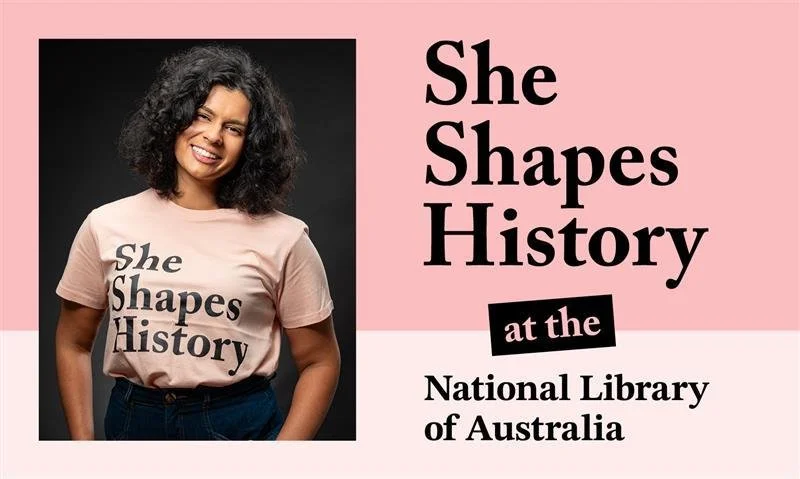
Where are the women in the story of Australia?
The answer might surprise you. The National Library of Australia holds one of the richest collections of women's history in this country: diaries, court records, photographs, oral histories, union files, objects, and more. Many Australians have no idea what's there. And much of what's in it has never been seen by the general public.
Over four years and twelve talks, She Shapes History founder and CEO Sita Sargeant is partnering with the Library to change that. Along with the events, we'll develop a digital hub with research guides and reading lists so by the end of the series you won't just know more about Australian history. You'll know how to find it yourself.
Join us for the entire journey, or come along to any one (or more!) of the events to hear from incredible speakers shaping history in their fields.
About The Speakers
Santilla Chingaipe is a Zambian-born filmmaker, historian and author whose work excavates the stories of Black and African-descended people in Australian history. Her book Black Convicts, which traces nearly 500 people of African descent transported to Australia as convicts, was shortlisted for the 2025 Stella Prize and the Queensland Literary Awards. Her SBS documentary Our African Roots was the first time an African-Australian journalist interrogated the nation's colonial history on Australian television.
Jacinta Mackay is a Wiradjuri woman, nurse, researcher and oral historian at the National Library of Australia, currently completing her PhD. As a 2024 National Library Scholar, she used the Library's Bringing Them Home oral history recordings to explore how understanding the history of the Stolen Generations can inform more culturally safe nursing care for Aboriginal communities. Her research centres the conviction that listening to Indigenous voices, in archives and on country, is essential to meaningful change.
Harini Rangarajan is a Chennai-born, Canberra-raised storyteller, archivist and musician whose work makes South Indian history, linguistics and culture accessible to contemporary audiences. Drawing on sociology, oral and folk tradition and archival research, she critically decolonises voyeuristic approaches to anthropology while spotlighting hyper-local Dravidian traditions overlooked by systemic injustice. In under a year, her Instagram Reels have regularly reached 200,000 views, drawing audiences to ancient languages, oral traditions and cultural history through accessible, research-backed storytelling.